



Four years into Labour’s control of Wandsworth, Cabinet Member for Housing Aydin Dikerdem reflects on council homes delivered, planning battles lost and won, and the difficulties but also the joy of what he calls “probably the most rewarding job in the world.” Ahead of Thursday’s vote, he speaks with unusual candour about what Labour achieved, where it fell short — and why he believes Wandsworth’s Labour group is a model the national party would do well to follow.
Aydin Dikerdem grew up in Wandsworth and went to school here. He became the Labour councillor after a by-election in Queenstown ward in 2016, aged 24 (meet the young Dikerdem here). Six years later, after less than two terms in opposition, he took on one of the most demanding jobs at Wandsworth Council when Labour won the 2022 local election and he became Cabinet Member for Housing.

We met at Battersea Arts Centre on a quiet evening. The bar was closed; we sat in a side corridor for a 90-minute discussion.
Dikerdem insists he is “not ideological” but “an evidence-based politician”, making a central case for his record: the more council homes Wandsworth builds, the less the taxpayer ends up spending on temporary accommodation.
In this long interview, he reflects on his impact, his pride in the council’s housebuilding programme, his fight to change planning rules in the borough, and his ambition to make Wandsworth a more inclusive place. He also addresses the financial pressures that may shape whoever wins this election, and he speaks frankly about where he has clashed with the national party.
We are publishing the exchange in full because it covers a wide range of subjects that readers and voters may find of interest ahead of this Thursday’s local elections. For clarity, you will find some headings to define the different sections of the interview. We have also added occasional colour notes, comments and links where relevant.
Clapham Junction Insider: Labour took control of Wandsworth at the 2022 local elections, after more than four decades of Conservative rules. What did you actually expect of the job, and how did that compare to the reality on a day-to-day basis?
Aydin Dikerdem: It was an incredibly exciting moment — we were full of ideas and had a really outward-facing sense of what we were going to do. And I think on that level, we have delivered a hell of a lot. When I read through the manifesto and look at everything we did, I think: wow, in four years we did pull off a huge amount: From 450 bike hangers to repaving roads and pavements, to 500 council homes — the list is endless.
The reason I really want us to keep going is this: when you take over a council, in some ways you think, “We have this machine — the town hall — and we get it to do what we wanted it to do.” What you actually learn is that when anyone has run somewhere for 44 years, there’s a lot of unpicking to do. There’s a lot of institutional inertia, in housing especially. And that’s where some of the creative new ideas came from — things that weren’t in the manifesto but emerged through the process of running the council. “Seven rings, seven Days,” for instance, wasn’t in the manifesto, but Simon Hogg [the leader of the Council – note from CJI] very rightly saw that he wanted to test which departments could be responsive, could adapt to a much more modern, outward-facing council. You couldn’t have thought of that until you take control.
I know there’s so much more reform, modernisation, and efficiency to be gained — so that residents feel they’re dealing with a much more modern institution. Repairs, for instance, are all handled over the phone. It’s so old-fashioned. There should be an app where you take a picture, it gets sent to an office, it wastes less officer time, you can track the repair, you know what date the contractors are coming. At the moment we just have these quite ossified processes.
Were you surprised by the way it actually worked in comparison to what you’d imagined beforehand, or did you already have a sense of it as a councillor?
In some ways, the Conservatives always claimed they ran a very efficient, effective council — but actually it was an incredibly old-fashioned one.
We’ve delivered a hell of a lot with the existing structures, and we’ve tried to change as much of those structures as we can. But there’s still a lot of scope for really exciting ways of making the council even more responsive. We had to bring that energy and culture to a council that probably would have just put up some notices and done it all quietly. Those are the things you don’t really see until you’re in control of the machine.
How would you describe a typical week as a Cabinet member?
It varies quite a bit depending on what comes up. My portfolio covers private renters, our council tenants, our council housing delivery programme, and the wider planning portfolio. There might be weeks where I spend a lot of time in Roehampton on the Alton Estate because we’re doing a specific piece of work on the regeneration and the new housing there. You have your meetings with senior officers. I quite like going for occasional “mystery shopper” coffees with estate managers to find out what’s actually happening on the ground — that’s how you pick up what the front-line experience is really like.
But the best thing about working for a council is that no week is the same. Things happen, life happens, emergencies happen, wins happen. One week might be a really good one because you managed to place a family you didn’t think you’d be able to place for a long time, or you found better temporary accommodation for someone — really nitty-gritty things. But I think what people don’t always understand is that the casework can be really tough and heavy — you take it home with you.
Housing delivery
Your 2022 manifesto said your first act would be to build 1,000 new council homes. The Conservatives had their own “Homes for Wandsworth” programme targeting 1,000 homes by 2027. Can you explain how you shifted the original scheme from what you inherited from the Conservatives?
The Conservatives had a programme called “Homes for Wandsworth” to deliver a thousand homes of different tenure types through an infill programme on our own estates and pockets of land we still owned. Around 400 of those were going to be council homes and the rest were going to be sale products — homes for sale or shared ownership. So only 400 council homes and 600 that would end up being sold off.
We had been really against this because those were the last remaining pockets of public land in the borough to deliver housing. We thought that if you’re going to build housing on public land, it should be council housing — the waiting list is huge. General needs plus overcrowding plus temporary accommodation: we’re talking over 10,000 people, with 4,000 in temporary accommodation alone. So, we were very clear we were going to flip the Conservative programme to 100% council housing. We are delivering out but just flipping the units.
When we first took over, Randall Close had planning permission and Kersfield (41 new residential units) was already in the process of being built out, so we had to move fairly quickly to ensure those wouldn’t be sold. Going forward, all the schemes the Conservatives had planned to build we turned into council schemes. Funnily enough, they then started opposing those very same schemes, even though they had planned to build them — particularly in Putney, on schemes like Ashburton. All our schemes are inherited from the Conservatives; the only difference is we’re making them council housing rather than for sale. And then suddenly we had Conservatives campaigning against those very schemes, which I found really difficult — morally, and in terms of the argument.
On that thousand-home scheme, we also adapted some things. On Garratt Lane, the Atheldene site — a regeneration the Conservatives had planned with 40% affordable housing — the scheme had stalled after Liz Truss’s mini-budget sent costs up, and the developer was struggling. We were worried the scheme would be left half-done, and there was a GP practice meant to be delivered. So we used some of the thousand-homes money to buy into that scheme and flip some of the units to council homes at build cost — good value. We tried to do interesting things with the thousand-homes money because we’re not purely ideological about it being only a build programme. If it makes sense to purchase into schemes, we’ll do that. Battersea Power Station — we’re using the thousand-homes programme there rather than going through a housing association [Over 200 new council homes at social rent levels are planned for construction at the Battersea Power Station site by 2029 – note from CJI].
There’s a lot of talk at the moment about how the market has dipped, costs have gone up, it’s a difficult time for developers. We used that moment to keep schemes going at good value for local people and keep construction jobs going by using the thousand-homes money in a fluid way.
In a recent press-release it says that you’ve reached the milestone of 500 completed homes by October 2025. And you’ve got 500 further to build?
Yes — we’ve built 500 and there are 500 ready to go with planning permission.
It also says the 1,000 new homes target is actually 2029. The original manifesto said it will be your “first act”, but didn’t specify a deadline. Was it always understood to be a two-term programme?
I was always very clear, and I always say this when asked at full council: we were flipping an existing scheme. You have to understand that house-building takes time. You have the actual construction phase — 18 months — but the planning and consultation stage also takes a long time, the consultation with residents. Even the Conservatives were never going to complete it in one term. It was always a two-term programme, particularly because it’s infill and has to be done in a way which is really robust.
Can you give a breakdown of the 500 council homes that have been completed?
You should post my Instagram video [Link HERE]. You’ve got Kersfield, which was flipped to 100% council. Putney Vale, Patmore Estate, Randall Close on Surrey Lane Estate, the homes on Gideon Road. They’re all around the borough. Some schemes are quite unique: in Furzedown we’ve got a scheme specifically for people with learning disabilities where a carer can live in with them. Bessborough Road, which we’re about to build out, will be for young adults with special needs. Many of the homes we build are wheelchair-adaptable, so there’s a really wide range of property types.
- From the schemes that we mentionned above, we can cite Randall Close [106 new Council Rent homes], Kersfield [41 new residential units] or Gideon Road [18 x social rent] and Tyneham Close that we covered in an article, Patmore street [57 Council rent homes] or under construction such as Garratt Lane [113 Council rent homes]. You can find the full detail on the council’s page.
There’s a bit of a slight misconception around the Battersea Power Station homes — they’re not actually inside the Power Station.
They’re on the other side of the road. Nobody needs council homes in the shopping centre. The Peabody Section 106 homes at New Mansion Square are on the other side of the road, whereas we’re on the actual site. It was really important to us that we were on the site, even if not inside the building.
- Unlike what apparently Aydin Dikerdem thought, you have multi-million luxury penthouses not only around the site but actually on top of Battersea Power Station building and a special site to market them. As it shows, starting at £7m you can get a flat on the roof garden of the power station – which is not simply a shopping centre.
On luxury flats, ubris and side entrances for some less wealthy tenants, read: Nine Elms: hubris and complacent Council leads to obscenity
In your new manifesto you repeat the 1,000-homes pledge and add a further 1,000 on top. If you’re only halfway through after one term and will only achieve the original thousand by the end of the next term, how do you deliver an additional thousand at the same time?
This is a really exciting part of the new manifesto. We’re going to use the Accelerated Funding Scheme and GLA grant to do more purchasing into Section 106, because the market is difficult at the moment and housing associations are pulling back from Section 106 — they’ve got so much to do with the regulatory environment. Grant levels are good and there’s a new Accelerated Funding Programme announced by MHCLG.
The additional thousand I’m talking about is not identical to the thousand-homes programme — it’s delivering council housing through a different route, where we can get very low costs.
- The Ministry of Housing, Communities and Local Government (MHCLG) initiative launched in July 2024 will be extended to smaller sites of under 500 homes. Furthermore, the Mayor confirmed a new £1.5 billion boost to help accelerate affordable and social housing across capital. Low-interest loans will be offered at 0.1 per cent.
So, in four years, 1,500 finished or started?
The second tranche — the accelerated funding route — we can’t really put a firm number on it, because some relies on Section 106 and some is net additional on regenerations. Broadly speaking, my target for the additional thousand would be around 2030.
There will be some Section 106s that come forward where we’d rather leave it for a housing association. But the commitment is that we are going to use that opportunity and that level of grant to deliver genuinely good-value council housing.
The Conservatives are very clear they are going to cut the existing thousand-homes programme. They are totally against it. They are open about it. Every scary leaflet you get about the debt is them deliberately miscommunicating the Housing Revenue Account borrowing to the general public.
Is the borrowing also for the additional thousand?
The additional thousand we can get through GLA grants, the existing borrowing regime, the Accelerated Funding Programme, and our regenerations. It’s a mixture. We have a pipeline of what we think the London Growth Plan will deliver, what our regenerations will deliver, and what private sites will deliver. And the way the government is encouraging house building is though this Accelerated Funding Programme. The cost per unit to the council is falling drastically if we use that route, so with the existing borrowing we have, we can squeeze out another thousand.
Wandsworth is planning to borrow up to £870 million over the next ten years, with the total cost taking the figure to over £1.1 billion. This was confirmed at committee by the end of 2025. You are explaining that the additional borrowing is not to cover day-to-day expenses and if you don’t need that money for the additional thousand-homes programme, what is it for?
It’s really important that residents understand that when we’re talking about this, we’re not talking about general funds borrowing. We are talking about the Housing Revenue Account, not a penny on their council tax. What this is: we are a social landlord that manages 32,000 properties, 17,000 of which are tenanted, and they all pay rent. We borrow against the value of those assets to deliver new council housing, and the rents pay for that. Once the homes are built, they generate more income for the Housing Revenue Account.
Where they save the taxpayer money is in temporary accommodation costs: the more council homes we build, the less the taxpayer has to pay for temporary accommodation, because people are placed in council accommodation and the rent they pay comes to the council rather than a private landlord.
The borrowing we’re currently doing is for the existing thousand-homes programme. It is curently funded with internal borrowing — we’re not going to market — because we have large reserves in our housing revenue (again, we are not talking about the Council’s General Fund reserves).
- Read our article explaining the Council’s reserves.
However, at some point we’ll go to the market. But we did not want to take out an external loan when interest rates were high, so we’ve been borrowing internally and we’ll only go to the market when rates are at a better level. We’re also pushing for access to the very low-interest loans the government has announced for house-building, which would allow us to borrow through the Public Works Loan Board at a lower rate. It’s not that we weren’t aware we’d have to borrow for the 1000 Homes, but we’re just choosing the most optimal moment. If you are borrowing internally, it is just buying time until you eventually go out to the market. Remember we took over just when the mini-budget happened, so we were going to wait for a better moment .
The borrowing that’s internal at the moment is on the Housing Revenue Account, and the external borrowing will also be against the Housing Revenue Account, with no charge for the tax-payer.
- The 1989 Local Government and Housing Act introduced the concept of the Housing Revenue Account which ensures rent payers’ money only gets spent on housing related expenditure. The debt is serviced by rental income rather than council tax, ensuring that local taxpayers are not subsidising social housing landlord activities.
Planning and Affordability
The authority monitoring report for 2025 shows that over the three years since you took over, you more than doubled the number of social-rent units compared to what the Conservatives achieved. However, in terms of tenure split, it’s still below target — below the current 35% target, in fact, sitting at around 24%.

The 24% figure is on completions, which includes legacy build-outs — the permissions we’ve been granting tell a very different story. When you look at the negotiations on planning permissions where we’ve been at the table, the splits we’ve been getting — even before we changed our planning policy — were remarkable. In policy terms our social-to-intermediate split was 50/50, and yet we were negotiating 70/30 splits because of our very clear signalling to the market that is what we wanted. Our permissions do show a dramatic rise in social housing in comparison.
When we changed our planning policy through Regulation 19, it sedimented what we were achieving through negotiation but gave us considerably more weight behind it. It’s important that the permissions have that level of affordability in them, because when the land does get used, we’re getting the best of it. If you look at the negotiated permissions, the level of social and affordable housing has really gone up.

In your 2022 manifesto you pledged 50% affordable housing on all new developments. That was then reduced to 45% in the submission to the planning inspector — and even that was rejected. You ended up at 35%. But when you reported back to cabinet, you said it was “very good news”.
- Read our interview of Aydin Dikerdem in december 2024, during the local plan change submission: Make Wandsworth more affordable: the big task of the Council
Regarding the level of affordable, that’s true. But we got nine out of the ten things we asked for. We got the 70/30 tenure split. We got provisions making it much harder for speculative student developments to crowd out residential buildings. We got the small-sites charge through, which helps us build affordable housing. “If you fight, you won’t always win. But if you don’t fight, you will always lose,” to quote Bob Crow.
In Wandsworth we get a lot of speculative products — co-living, student accommodation — and we’ve made it so we can negotiate genuine rental accommodation out of the Section 106s on those. The details matter. Our big headline was what we fought for, and we didn’t win that one — but you know this area inside out: you can recognise that this is genuinely progressive policy.
It wasn’t a case of “let’s wait until the next local plan and make our lives easy.” We clashed with officers who had just signed off a local plan just before us taking the council, and went through Regulation 19 line by line to make our case. I hope that residents will recognise it. Those details might seem small but they translate into 10, 20, 30 social units here and there — and those have impact real people. They’re the ones in my inbox, calling me, texting me during this very interview: overcrowded families, families on the waiting list. I’d do it all again in an instant.
We basically got everything except the big-ticket headline item. And to be frank, three weeks before the inspector’s decision — after two years of work — we were kneecapped by the threshold change.
- Read our article regarding the outcome just before the final adoption.
Yes, the Mayor of London changed the threshold to 20% in an agreement with the government. How did you feel when you read that news?
I spoke out against it publicly and I continue to think it’s a mistake. My officers, after two years of viability testing, could show that at 45% affordable, 70% of our large sites remained viable. That was the evidence base we had.
What the inspector said was that we’ve only just started hitting 35%, so keep going at that for a while before breaking with the GLA’s 35%. That’s a frustrating outcome for an ambitious council — we believed it and we could show the evidence. The national headwinds were against us; we knew it would always be tough. But I’m glad we have a Labour Council that doesn’t shy away from ambitious fights to get the best for our residents. We’ll probably go back and try again, because once we can consistently demonstrate we’re hitting 35%, we’ll have the evidence base to push for more.
It is the role of any progressive council to maximise public good on private sites, and we’ll continue to use every power we have to do that.
Renters and the Private Sector
The Labour government’s Renters’ Rights Act ended no-fault evictions and introduced new rights for tenants to challenge rent increases. Your manifesto promises to help renters appeal to the new renters’ tribunal. In practice, what does that mean?
Under the old regime, if your landlord raised your rent and you believed it was unfair, you could go to a tribunal — but if you lost, the increase was backdated to the date it was first proposed. As a result, very few renters pursued this route, as they would have to repay the full increase retrospectively. Those who did challenge it often found the process extremely stressful, and typically only did so because they could no longer afford the rent, so they do it out of desperation. The new Renters’ Rights Act changes this: if you lose, the new rent applies only from the date of the tribunal’s decision.
From 1st May, when the Bill becomes law, we as a council are going to have a part of the service that supports any tenant in going to tribunal. We will advise them, give them support, help them submit. We may well procure an organisation to do this, and then collectively submit rent increases to the tribunal — effectively buying tenants time to have a rent freeze while the outcome is awaited. It becomes much more normal for a renter to challenge an unfair rent increase.
Why that matters is that smart landlords will see they could be waiting 12 months for a tribunal decision. So, they might go back to their tenant and say, “Look, I know you could go to tribunal — I wanted to raise it by this amount, but what can you afford?” And for the first time since the 1988 Housing Act was scrapped by Thatcher, tenants have some negotiating power. We just haven’t had that in this country. In France, there are rules and regulations about how much rents can be raised.
You’ve been personally in favour of rent control. The Labour government is not promoting capping rents — only tighter regulation.

Have you seen the Guardian headline this evening? Much to my joy it says “Rachel Reeves considering rent freeze to limit Iran war fallout“. Perhaps my videos have been seen by Rachel Reeves?
Joking aside — we had rent controls in this country for many years. They were scrapped by Margaret Thatcher. Since then, it just about got by until the 2008 financial crisis and the wave of asset inflation that followed. The rent crisis at the moment is untenable. If we want to grow our economy, we cannot have young people giving half to two-thirds of their income to landlords rather than into the real economy. Rent control is normal — it happens all over the world, with good and bad examples. Europe uses it widely.
There are broadly two forms of rent control: limiting how much rent can be raised, and capping how much rent can be advertised for a new tenancy — as they do in Paris and other European capitals. So what sort of rent control are you promoting?
I’m an evidence-based politician, so I do care about not producing a major squeeze on supply if you lurch into rent control without thinking it through. My understanding of how renters experience renting in London is that it’s the insecurity of the increases — not being able to plan — that does the most damage. I’d lean towards a stabilisation model where there’s a limit on large jumps and a built-in understanding that rent can only rise by a certain amount each year.
What’s most unfair about the current system is that under short-hold tenancies, the landlord can say at the end of the term: “Agree to my rent increase or you’re out.” It’s a total monopoly and it is devastating lives. That has to stop. I’d want to be led by the evidence — the best reports I’ve seen on this are by the New Economics Foundation and Shelter.
Another manifesto pledge — both in 2022 and again now — is extending landlord licensing borough-wide. What’s the difference between the current position and a full borough-wide scheme?
We’ve already done HMOs borough-wide. What we’re moving towards now is building out selective licensing incrementally. At the moment selective licensing is only in Tooting Broadway. We’ve just expanded it to East Putney and Northcote, and we’ll continue doing it in waves, prioritising where the need is greatest.
- A House in Multiple Occupation (HMO) is a property rented out by at least three people who are not from one “household” (e.g., not a family) but share facilities like a kitchen, bathroom, or toilet. As of July 1, 2025, Wandsworth Council introduced new, stricter licensing schemes for landlords. More details on the Council’s website.
How do you choose where to roll it out?
It’s all through evidence and data analysis. You might think, “Why Northcote?” — I wouldn’t have guessed that either. But when you look at the age of the stock, it throws up risks you wouldn’t necessarily think of, to do with fire safety and so on. It’s not political. We’re rolling it out based on where the need is, not where the marginal seats are. That’s why Tooting was first: huge number of renters, poor-quality stock, high number of category-one hazards, high number of rogue landlord cases. We’re expanding out from there.
The Homelessness Hub
The Homelessness Hub was one of your 2022 pledges. It was initially highly controversial — in part due to what we reported at the time on CJI as poor communication from the council. When it was finally approved in May 2024, even the opposition councillors were supporting it, and it appears to be working well. What do you make of that whole episode?
On the Hub, we’ve already got some amazing case studies. People who hadn’t engaged with our services for 14 years are now taking up accommodation. At the last count nine people had moved through — it’s all going in the right direction.
- Read our latest article about the Hub: One month in: A massive innovation in progress for the new Rough Sleepers Hub
On the process: as I said at the beginning, some things about the council machine are not excellent. Communication is always difficult. The original hiccup — which you monitored on Clapham Junction Insider — was the way we consulted on the scheme. It was a little notice on a lamp post.
- Indeed we covered the difficult start in a number of articles, for example here and there, upd to the final planning application approved and the opening.
I hope people saw that we were open to putting our hands up, saying sorry, and then actually doing something about it: setting up the residents’ forum, holding meetings, being accountable. I sat there at those meetings — remember that time when everyone crowded round, you’ve got a photo of it, people were really animated — and I led it from the front. I didn’t get the officers to do it for me. We did it together as a team.
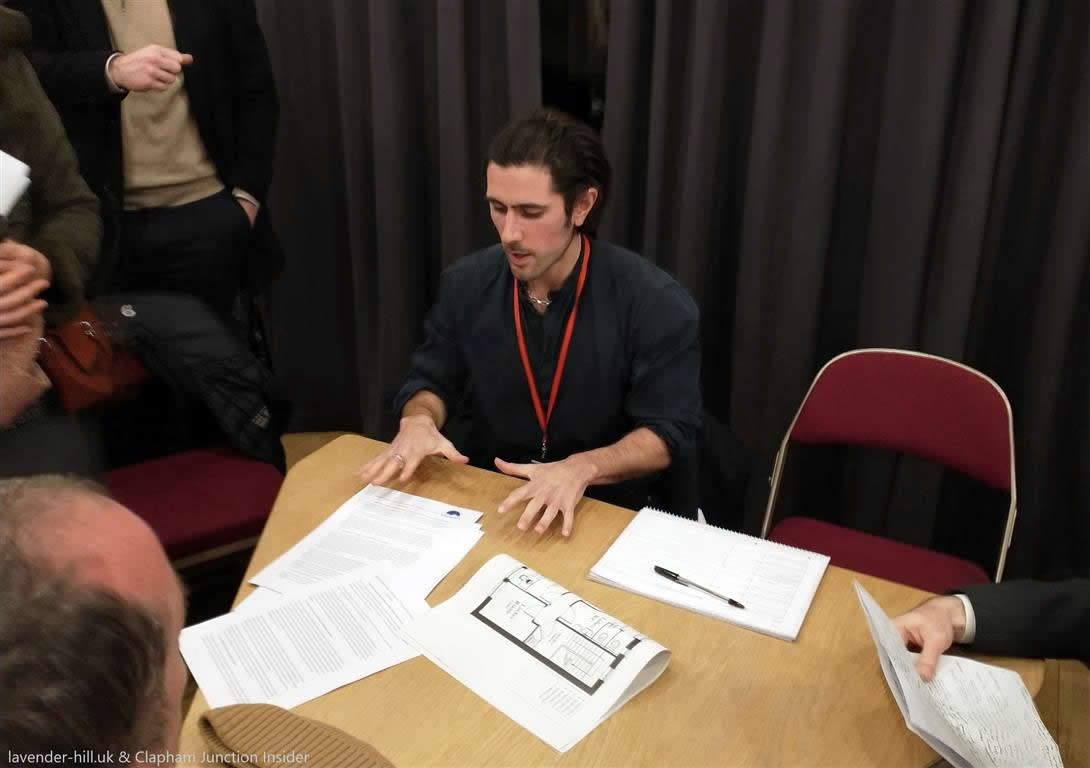
- You can read our report of the meeting here: Rough Sleeper Hub approved on Lavender Hill in a highly consensual meeting
For me it was also a really useful learning exercise as a Cabinet member. In some ways it was made easier because it was at the end of my own road — I could easily say, “You wouldn’t want this here? It’s where I live. I walk past it every day.” The lesson I took from it is that even when difficult things are coming forward, you have to be as open and transparent as early as possible — otherwise the rumour mill starts. The first couple of meetings we spent entirely myth-busting things we could have pre-empted if we’d just been more upfront from the beginning.
Council Finances and Council Tax
Let me set the context. The Labour government changed the rules for grants to local authorities. Wandsworth is one of only five London boroughs that are net losers under the new government formula. The Institute for Fiscal Studies has estimated Wandsworth may need to raise council tax by around 75% simply to plug the funding gap. Wandsworth’s own forecasts suggest the council tax requirement could double by 2027-28 to £143 million and reach £178 million by 2028-29 — and those projections already assume the maximum permitted annual increase of nearly 5%. Your number one manifesto pledge is keeping the lowest council tax in the country. Is that still credible?
- Read our article: A financial timebomb: what Wandsworth isn’t saying about council tax
Yes, because we’re very clear. There’s a lot to unpack here, but the most important thing is that there’s a fundamental contradiction at the heart of the Conservatives’ financial narrative. They claim we’re spending down all our reserves whilst simultaneously about to hike council tax — and that the ceiling is about to fall in. Part of our strategy on reserves is that the Conservatives hoarded reserves at the cost of frontline services and infrastructure — which is partly why the grant is being cut, because if a council has too high reserves, the government doesn’t regard them as deserving of grant. Meanwhile, the Conservatives lost money to inflation on that reserve strategy. They had this war chest while cutting youth services and not investing in their housing stock. [Wandsworth has got around £200 million in reserves at the moment].
When we first took over the council, we were also presented with very scary forecasts about massive budget gaps — and they didn’t materialise. When it comes to the fair funding arrangements [the government re-allocation of the grant given to local authorities, where Wandsworth is going to lose funding], the choice for the electorate is simple. The Conservatives are very clear about what they’ll do: cutting Access for All, cutting the Decade of Renewal. It’s a traditional austerity programme. To make up the gap they are going to cut back on the services that I think residents have noticed over the past four years and have made their lives better. We, on the other hand, are going to fight this settlement. Who would you rather have fighting it — a Labour council or a Conservative one? I think residents would rather have a Labour Council that can make the case about fairness and the funding for Wandsworth.
And the second thing is the amount of inefficiency in this council that the Conservatives have run for 44 years. The transformation potential is enormous. We got the machine to deliver what we wanted. But the machine itself is a second term programme. Just in housing alone: officer days wasted on phone calls that could be handled online; homelessness teams typing up case notes when we now have the technology to just record the case, have it transcribed, and automatically enter it into the system so we can start finding placements. We are halfway through that transformation — with Seven Days, with the streamlining of services, with the triaging in the call centre.
The last thing I want is for us to abandon that work and just cut back services.
But your manifesto says you “froze council tax for four years in a row.” But residents see an increase on their bill — the overall amount they pay does go up. They are not considering that they pay that amount to the mayor of London, that amount to the Council itself, that amount for social care. Can’t you see that people might be annoyed by the same rhetoric that they heard for years and years?
This really pisses me off, because the Conservatives changed the rules of the game.
Why do you play the same game? You highlighted at the Council meeting that the Conservatives did exactly the same – which they acknowledge – so why are you trying the same tactic?
It is totally bad faith. When we were in opposition and they froze council tax but raised the social care precept, we did not accuse them of lying — because we completely understood what was happening. They were freezing the main element and raising the social care precept. That was the norm that had been set in Wandsworth politics for decades by Edward Lister and Paul Beresford. The year before the 2022 election they even claimed to have cut council tax, even though the social care precept went up. And we didn’t throw a hissy fit then.
The reason we did the same thing is not that we thought the Conservatives were being misleading — it’s that they had set the norms, we froze the main element, and it never occurred to us this would be controversial. For more than ten years I never read an article or saw a tweet claiming what the Conservatives were doing was misleading — not one newspaper, journalist, or resident. It was only when the Labour Party did exactly the same thing that suddenly press releases were fired off. That’s why it was not on our radar, because we did not thing that the Conservatives were being misleading, and we were doing exactly the same thing.
And we know why suddenly it became controversial: it’s because that frozen council tax was the only policy the Wandsworth Conservatives had. It was the only thing that kept them going — they charged kids £2.50 to use the playground, they sold off 20,000 council homes, they allowed developers at Nine Elms to build with no meaningful social benefit. The one thing they had was a local tax. And the reason they’re so angry and put out several leaflets about this, to smear us for the exact same thing they have done, is because they know we have so much more to offer — and we’ve frozen the council tax as well.
- Unlike what Aydin Dikerdem states, it did not suddenly become controversial. CJI reported of the misleading rhetoric immediately after Labour started to use exactly the same argument, and that it is actually the reason why we did not talk again about it recently. But the Labour Council cannot say that it was not reported before and they should have been aware of it. See our article in March 2023: Is Labour misleading Wandsworth residents on its Council tax rhetoric?
But isn’t it a bit like saying “everybody’s cheating at the exam, so why is someone only pointing the finger at us“?
No — because the GLA precept is not in our control. The only element in our control is the main element of council tax, and we have frozen that. The social care precept is a Tory trap, invented by Eric Pickles [Secretary of State for Communities and Local Government from 2010 to 2015 in the government of David Cameron – Note from CJI] to shift blame onto councils. We’re taking sovereignty over our bit, and on the one issue the Conservatives claim to own — council tax — we’ve shown that freezing it is the right thing to do when everyone is feeling the squeeze of the cost-of-living crisis. Food bills are going up, energy is going up — we’ve shown for four years that we can be trusted on this. Council tax is a regressive tax that hits poorer people hardest. As a socialist, I don’t think a regressive tax should be used to plug a structural fun ding gap.
The government gave some councils the power to raise council tax beyond the 5% cap. Your manifesto says you did not ask for that power and will not use it. But at the March full council meeting, the Leader was quite evasive about the long-term council tax trajectory. You were the one who stepped in to handle those attacks — not the Leader, not the Cabinet Member for Finance. Is refusing to give a straight answer on that not itself a form of misleading voters?
Absolutely not — I’ve just said clearly, we’re not going to use that power. I’m a democrat: Any government that gives us the power to throw it and not do something by referendum, I would not do that.
On the town hall: Simon and Angela can do things I can’t do, and I can do things they can’t. Simon is one of the greatest council leaders in London. Having worked in his cabinet, I cannot think of someone who understands the detail and the skill required to run a local authority in the way he does. I’m in awe of what he achieves every day. I happen to be a socialist who likes to argue in politics and am reasonably good at speaking in a council chamber — a lot of people get scared in that environment. Many of the Conservatives were privately educated and had debating societies; many of our members came from normal jobs and aren’t used to that theatre. What matters is that Angela has run a council with some of the lowest debts and highest reserves in the entire country. Councils across Britain would be desperate to be in the financial position that she’s left. My colleagues are incredible.
Angela said that reserves, the transformation programme, and efficiencies will “buy time.” But it looks like the council was taken by surprise by how radical the funding change was. When I read the manifesto, it feels a bit like — and I’m thinking of Rachel Reeves in 2021 — you’ve set yourself such strict fiscal rules that you’ve left yourself no headroom if things are harder than expected.
Council tax is a very small proportion of the Council’s budget.
- This is not true when considering the Council’s annual budget which covers the estimated annual running costs of council services, including employees, premises and supply costs, and income from grants and customer charges. As we wrote in an analysis published in 2022, “The share of Council Tax is 32% of the Service (Revenue) Budgets, not 5%. We are only close to the 5% if we consider the global ‘accounting’ document which includes not only the cost of services but also the maintenance of properties, the rent income, and even the change of valuation of the different assets owned by the Council”. Read our full analysis published in March 2022: Understanding the “Lowest Council tax” slogan
The difference between us and Rachel Reeves is about progressive taxation. Council tax is not a progressive tax — it’s regressive. As a socialist, I don’t think a tax that hits low-income people hardest should be used to deal with a structural financial challenge.
We’re going to solve this through transformation, not off the backs of our residents. And a Labour council negotiating with a Labour government is going to be in a much stronger position than the Conservatives would be, because I think there is room. When we took over the council, we were sat down by officers and told to expect a really difficult financial settlement — and it didn’t materialise in the way they feared. We’ve been through this journey before and we know how to navigate it.
The decision for voters at this election is: do you want a Conservative administration that will simply cut back on everything that’s been making people’s lives better or do you want a council that’s not afraid to fight, to transform, and to find a better way through?
National context and immigration
Wandsworth is a Borough of Sanctuary. But the national mood on migration is increasingly hostile and Reform is growing. Does that create a harder political environment for you?
There is nothing more frightening at the moment, as a Muslim councillor, than what I’ve seen over the last couple of years — online, and on the doorstep, where people sometimes say things not knowing I’m Muslim. We’ve gone backwards. Most of my life, broadly speaking, social progress has continued — when I was at school, people were more homophobic than they are now. I thought things had got better, and we are now going backwards. Reform, anti-migrant rhetoric.
In Wandsworth, we are categorically clear: our values are those of inclusivity and tolerance. The waves of migration we’ve had here historically — from the Huguenots to the Irish who built that power station, the Somali community we have in Battersea, the South Asian community in Tooting — that diversity is our strength. We’re not going to allow any of that to be undermined.

There’s a speech — I think it’s the best speech I’ve ever seen in Wandsworth Town Hall — by a Labour councillor called Sarmila Varatharaj. I put it on my Instagram because it’s the most moving speech, and it’s about migration, about being a Borough of Sanctuary. For us, it’s a clear red line.
At the last council meeting, when I was talking about Access for All, a Conservative councillor muttered, “Oh great — giving refugees free gym and swim; put that on a leaflet.” And I turned to them and said: “We are absolutely proud of that. What are you talking about?” It’s not something we’re going to shy away from.
The whole system around asylum is obviously ludicrous — when you see people on the street saying “they’re coming here and getting everything but they’re not working,” the truth is that the hostile environment doesn’t let people work. The whole system is being used to generate racism, and racism has always been used by the ruling class to divide everyone else. That has historically always been its purpose.
In housing particularly, you see it creeping in — there’s a shortage of housing, a shortage of council housing, and that’s an easy place for the far right to ask: “Who’s getting it and why can’t my family get it?” We have to be absolutely solid on these questions. I think some of the directions the national Labour Party has taken on these issues benefits no one — they’re not going to win over Reform voters with it, and they’re going to alienate their own progressive voters.
It’s presumably something you think about when you’re canvassing. Keir Starmer isn’t that popular right now. How are you received on the doorstep?
People literally say, “You guys run a really good council. I like what you’ve done. We love the free bulky waste collection, we love the mega skips, we love that council tax is the lowest in the country.” People genuinely say that.
But we know that at local elections, people are often thinking about national questions. So it’s our job as a local Labour group to fight for our record locally and on the areas where we’ve held our ground — being a Borough of Sanctuary; the affordable housing threshold; for me, really important thing, on Palestine, on the ceasefire; I went to every single demonstration. I support our divestment work. We have a Labour group here that looks out for each other, a broad-church Labour group that hasn’t fallen into the kind of nonsense you sometimes see at the top.
That’s why I, as someone on the left of the party, am a deep believer in what we’ve built here and in the pluralistic culture that I think is a model the rest of the Labour Party should take a lesson from.
Looking back and Looking forward
To conclude — looking back at the last four years, what was most difficult, and what are you most proud of, what do you think you did best?
Undoubtedly the most difficult was council estate housing management, the regulator result.
- In Wandsworth, the official result from the Regulator of Social Housing published on 26 February 2025, was a C3 grade, which is the second-lowest possible rating. That rating was backed by findings that the council had serious failings in housing management and needed substantial improvement. A widely reported article summarising it appeared in The Standard]
We inherited a 44-year-old machine and we’re in the process of transforming it. I really want another four years to see that through. We’re going to do a 100% stock condition survey; we’re going to change how we engage with our tenants. There’s a huge amount of work still to be done.
In terms of the most rewarding — the most honest thing I can say is it’s always the casework. It’s those individual moments: a family moving into their new home; or the renter who was treated terribly by their landlord, who came to me almost by accident and said, “Is there anything that can be done?” The property wasn’t licensed, so they’re getting a 12-month rent repayment order after being treated terribly for a year — constant threats, their mental health collapsing, and the landlord hadn’t even licensed his property. It’s those stories that keep it all going. And the Hub too, finding that rough sleepers who for 14 years didn’t engage with our services at all are now finally engaging because we created something totally unique.
I think it’s probably the most rewarding job in the world, especially when you live here — I grew up here, and I get to see things like Falcon Road Bridge that I’ve always wanted to see improved.
You only want another four years, not another 40 to match the Conservatives?
When I read through our manifesto, I thought: we did a lot. We really did. And I want to see it through, because there are things — particularly around how the council works and how it interacts with residents — where I think we’re right on the cusp of something transformative. The other 500 council homes are ready to go, and if we lose, they will simply be cut. But we know we have to earn every single vote.




Interesting interview.
I don’t think he clarified the funding gap and spending for the future very clearly. Worrying, given the cost of living crisis, that will only get worse given the orange fella in the US.
Nine Elms and the old B&Q/Homebase in Wandsworth must have been a major windfall for WBC, that size of development won’t happen again in the borough. I’m hoping Labour don’t think they can spend all the reserves, build on every green space and facilitate housing (and ‘free gyms’ – FFS!) for the third world in Wandsworth.
Lastly, given the economy, was it really necessary to rebrand the Councils logo everywhere, surely unnecessary spending?
The cycle of ‘spend and bust’ is a well worn theme for Labour, I hope WBC don’t repeat it.