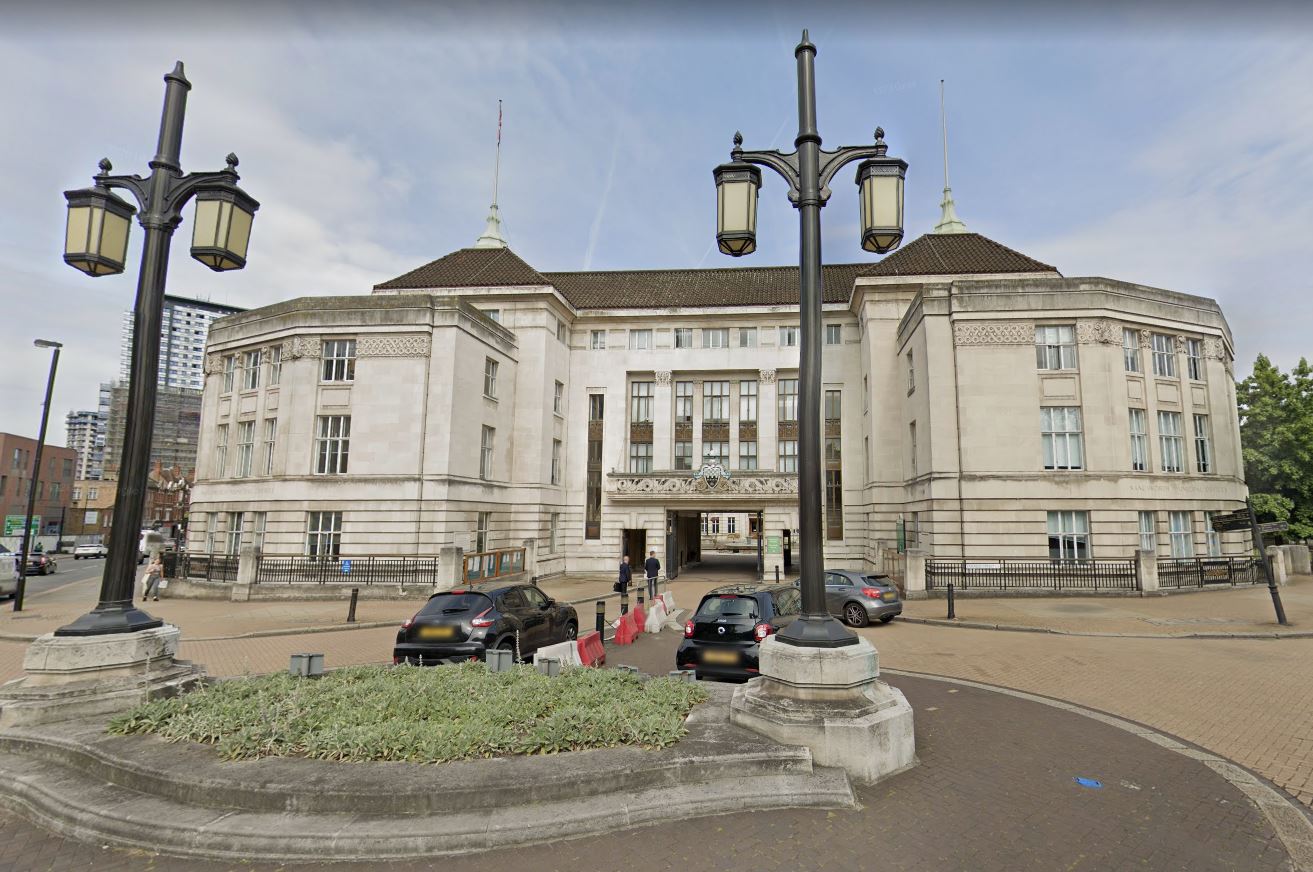




From Southfields station to the Royal Courts of Justice, a vocal SWP crowd rallied outside the Royal Courts of Justice for the opening of a pivotal High Court hearing on whether a 150-year-old statutory trust protects the golf course land from the All England Lawn Tennis Club’s controversial £200m expansion.
Despite the cold weather (at least without rain) —a stark contrast to last July’s warm sunshine—a similar group of cheerful Save Wimbledon Park (SWP) supporters began their now-familiar transhumance from Southfields to the High Court early Friday morning, January 16th, to demonstrate at the start of the new court hearing against the Wimbledon extension. At least this time there was no delay during the commute.

SWP had a rendezvous with the All England Lawn Tennis Club (AELTC) at the Rolls Building for the first day of the High Court case to decide whether the land the Club planned to build on was subject to a ‘statutory trust’ for public recreation. The courtroom was packed and overflow seating was organised, but once again—as in July—the diffusion system was poor and audio barely audible.
Local councils divided but City Hall gives green light
Wimbledon Park is a Grade II listed historic landscape, comprising 27 hectares of green space and a 12 hectare lake. Situated less than 10 miles from central London, the park is an important area of natural beauty, supporting a rich diversity of wildlife and valued as a place for refuge and recreation by locals and visitors alike.
The AELTC plans presented in 2021, propose a major transformation across part of the park: an 8,000-seat show court rising 28 metres high (the size of the Royal Albert Hall), 38 new grass courts, ten additional buildings including a 30,000 sq ft maintenance facility, and around nine kilometres of new roads and pathways extending over a former golf course.

Merton Council first gave its approval in October 2023 — though not without misgivings. Its own leader at the time questioned the scheme’s legal soundness, and the council’s officers acknowledged the proposal would be “inappropriate” for Metropolitan Open Land and cause “physical harm.” Even so, the report concluded that these drawbacks were outweighed by the “very substantial public benefits.” Six Labour councillors voted to back the scheme — a decision critics suspect was influenced more by the project’s economic allure than by residents’ objections.
Across the boundary, however, Wandsworth Council took the opposite stance on the following months and rejected the plan (money being absent for Wandsworth, there was no benefits that could balance the decision).
That left the final call to City Hall. On 27 September last year, the Deputy Mayor for Planning, Jules Pipe, acting on behalf of the Mayor of London (who has been openly supportive of the project), granted full permission for the AELTC’s expansion on behalf of the Greater London Authority.
The Trust dispute explained
Despite public authority approvals, key legal uncertainties persist—primarily whether a statutory trust protects the former Wimbledon Park Golf Club land from the AELTC’s expansion.
These trusts, rooted in the Public Health Act 1875, grant permanent public recreation rights over land acquired by councils for open space, barring buildings or major changes. The Local Government Act 1972 allows disposal only after public advertisement and consultation; absent this, as reaffirmed by the 2023 Supreme Court Day v Shropshire ruling, protections endure regardless of council error.
The central question is whether the golf course land was protected when Wimbledon Corporation bought the estate in 1915 and transferred it to Merton’s Council in 1965.

SWP research suggests that when Merton Council leased the land in 1986 and sold the freehold in 1993, it failed to discharge the statutory trust from the estate’s 1965 acquisition. The GLA’s own King’s Counsel, Timothy Morshead, supported this interpretation in September 2024, explaining that under 19th-century local government legislation, the land remains held for public recreation. This would have required Merton Council to publicly advertise the renewal of the lease in 1981 and the sale in 1993—which it apparently did not. If correct, both the 1981 lease and the council’s reversionary interest remain bound by the statutory trust, extending to any current leaseholder or owner.
AELTC argue that first, they did not know of the trust’s existence at the time and second, there was in fact no need to advertise as the golf course was a private facility. However, their position appears contradictory: while they argued there would be no “insuperable difficulties” in releasing the land from any trust or related covenants, they simultaneously stated in their legal proceedings that if such a trust were confirmed, their proposed expansion would be “incompatible” with development.
Last July, the AELTC and SWP met for the judicial review triggered by the local community group, arguing the GLA unlawfully granted planning permssion to the Tennis Club. While rejecting all grounds in his ruling, Mr Justice Saini commented that the GLA had “granted planning permission on the presumption that the Golf Course Land is subject to a statutory trust requiring it to be kept available for public recreational use”. However, AELTC chair Deborah Jevans believes that “there is not, nor has there ever been, a statutory trust over the former golf course land.“
The Club agreed to cover the legal costs of SWP, serving as representative defendant in the proceedings. This is a significant commitment, given that legal bills in the previous judicial review reached nearly £200,000 and were paid through community fundraising.
Lords’ attempt to clear the path for AELTC
In late 2025, supporters of the expansion attempted to bypass the courts entirely by proposing a House of Lords amendment to the Planning and Infrastructure Bill. The retrospective legislation would have rendered the current court case unnecessary—effectively clearing the way for AELTC’s development regardless of any statutory trust. The amendment was ultimately “not put” after significant opposition, raising questions: if the expansion were so clearly legitimate, why the need for emergency legislation to sidestep legal scrutiny?
Following the failed amendment, the government promised to consult on protecting public rights in open spaces like Wimbledon Park, but that consultation has yet to begin. When questioned in the House of Lords on December 23rd, Baroness Taylor of Stevenage, who is leading the consultation, stated: “Open and green spaces are an essential part of local social infrastructure and must be protected for future generations.“
Campaigners argue a better scheme is possible
As 9am approached, dozens of protestors had gathered; brandishing placards bearing slogans such as “paws off my park”, “land in trust for all of us” and “ace the cause, save the park”. The familiar ‘Berry Angry’ mascot was there once again, this time joined by two giant tennis balls and a champagne bottle.

Their synonymous chants rang out along Fleet Street, drawing glances from passers-by making their way to work and filling the crisp morning air with a sense of optimism ahead of the first day of legal proceedings.
All had been vocal critics of the AELTC plans for years.
- Read our July’s report: Wimbledon tennis on court and… in court!
Jonathan Morrish, in charge of communications for SWP campaign, was delighted by the turnout.
“I think it shows the level of support from around the community to try and stop this development. We’ve been together for nearly five years now, raised an awful lot of money at the moment. And there is a huge commitment to making sure this development doesn’t happen in the way that Wimbledon actually wants it to happen and is planned at the moment.”
The Tennis Club claims to “have spoken to more than 10,000 people who have taken the time to come in person and understand [their] plans in detail“. Deborah Jevans asserted that “The vast majority of people just want us to get on and deliver the many benefits on offer as soon as possible.”
However, this is not at all the opinion of local resident Sophia Browning:
“[The AELTC’s] definition of ‘engagement’ means telling us what they’re going to do. They’ve been presenting their plans for the last five years without listening to any feedback at all. They did a consultation which actually finished after they’d already submitted their plans, so they never had any intention of taking note of it. So no, that’s simply not true.”
Paul Hargreaves, another demonstrator, said:
“They’ve spent many, many thousands of pounds bombarding us with leaflets, making statements that are not proven in law. For example, that there never was a trust for land to be held for public access. They stated that as if it’s a fact, and only recently they said, ‘Well, we’d better check that out, of course, anyway.'”

Speaking to demonstrators outside court on the first day of the hearing, among residents and campaigners’ biggest concerns was the precedent that a victory for AELTC would set for the protection of green spaces across London and the UK more widely. Local resident and SWP campaigner Simon Wright explained:
“When we were in court before, our KC described Wimbledon Park as the most protected land in London. If AELTC are allowed to build on it, it means that none of the other 50 sites who have the same status, which is Metropolitan Open Land, the same as Green Belt, none of those sites are safe.”
While they may have been labelled as “Nimbys” by the press, Christopher Coombe, director of SWP, raises the significance of the case at a national level:
“There are cases all over the country. We’re just one of them. We’re not Nimbys, we are fighting because we know our local area best. We are going to do our very best because this is such an important national issue and we believe we have right on our side.”
SWP complains that AELTC is not interested in engaging in proper discussions.
“We have plans drawn up by a professional sports architect that show they could accommodate the stadium and all that they want on their side of the road and leave the park as it is now,” Jonathan explained.
He added: “They haven’t sat down with the real residents’ associations that surround the site for a long, long time. And, you know, they did promise back in April 2018 that this development would proceed in partnership with the community. And that really hasn’t happened. So I think people feel very let down by that.”
SWP keeps repeating that they are not against the Tennis Club’s development, but they want to be consulted and they want it done in a sensible way.
Paul Kohler MP, the Wimbledon Libdem MP, who became involved in the campaign after feeling his community’s voice had been ignored, said AELTC had failed to engage democratically with his constituents:
“If they had talked to the community, there would be a compromise. We would all get together and work towards something. Remember, my constituents are very proud of the tennis, they also love Wimbledon Park. Those two things should not be in conflict.”

Kohler has sought to reopen dialogue between the Tennis Club and SWP campaigners in an effort to explore whether a compromise might still be possible, so far with no success.
But he also warned that even if AELTC prevails in the court cases, there remains what he calls “the biggest obstacle of them all“—the legal covenants made by the Club in 1993, when they bought the land from Merton, never to build on it, which remain enforceable by the Council.
And he criticised Merton’s Labour councillors, saying:
“Labour have been missing throughout this process. Merton’s Labour Council refused to say they’ll enforce the covenant. Remember, there are covenants over that land. Even if they lose this case today, there are covenants over that land where there are legally important promises not to build upon it. And who can enforce that? Merton Council. Who runs Merton Council? The Labour Party. Although they have refused to say they would enforce the covenant.”
As in last July’s judicial review, Fleur Anderson, Labour MP for Putney, and Leonie Cooper, Labour London Assembly Member for Merton and Wandsworth, were absent.
What next
The current court hearing will determine whether a statutory trust protects the golf course land, with a decision expected within weeks rather than months.
In any case, this is far from the end of the legal road, and the Wimbledon extension seems to be a never-ending story—one that happens more in court than on court nowadays.
After six days of evidence, Mr Justice Thompsell indicated his judgment would carefully examine all the complex legal details. Campaigners remain cautiously optimistic, though AELTC suggested it could appeal any unfavorable ruling all the way to the Supreme Court.
In anticipation to the verdict, Sophia Browning said:
“I don’t think this is the end of the road for the statutory trust. In addition to that, we have two other avenues that we’re pursuing, as you’ve probably known. One of them is the appeal of the planning and the other one is the covenants, which haven’t been addressed at all yet.”
Indeed, the Court of Appeal has granted SWP permission to challenge the planning permission itself, following a July ruling by Mr Justice Saini that proved highly controversial.
Justice Saini ruled that planning authorities don’t need to consider whether a development can actually be built legally—they only need to decide if it would be a good idea. In this case, that meant the GLA could approve the expansion even though they acknowledged the land was probably protected by a trust that would make building on it illegal.
Critics argued this created an absurd situation: the GLA approved the expansion despite acknowledging the land was likely subject to a statutory trust that would make development illegal. In effect, Saini’s judgment suggested planners could greenlight projects while effectively ignoring whether they could ever legally proceed—a position that raised fundamental questions about the purpose of planning law itself.
- Read our analysis: High Court rejects challenge to Wimbledon expansion, but legal battle continues with Trust and Appeal cases
In November, Lord Justice Holgate agreed the ruling deserved a closer look, saying the appeal had “a real prospect of success” and that key legal questions about deliverability and public interest “merit review by the Court of Appeal.”
That two-day appeal hearing has yet to be scheduled.