

Behind the tax ‘freeze’ rhetoric, a a significant financial pressure is building in Wandsworth. Changes to Whitehall’s funding formula will strip millions from the borough and implicitly assumes far higher council tax in return.

“Wandsworth Council is freezing your Council Tax for the fourth year in a row” was proudly announced by the Labour’ administration a few weeks ago. Pink leaflets, bearing a new logo strikingly similar to the official council’s, were dropped through letter boxes across the borough ahead of this spring’s local election campaign.
As is so often the case, reality lurks between the lines. Council tax in Wandsworth will not, in fact, stay the same and it will rise. The council has agreed to increase by 2% the portion allocated to the social care levy, the maximum permitted under current rules. And since council tax comprises three separate elements, residents must also contend with the third: the Mayor of London’s precept. That figure is set to climb by 4.1% (equivalent to £20 on an average Band D property) to fund policing and the fire brigade.

Following the large Labour communication on next year’s council tax, many pointed on social networks the misleading calculation at the heart of the announcement. Clapham Junction Insider chose not to run a dedicated piece, frankly, because this is precisely the same ‘trick’ deployed in previous years, which we have already covered in detail.
Central government strips Wandsworth of grants
With an ageing population, a cost-of-living crisis driving up demand for support, and a housing shortage requiring substantial investment, the decision to freeze the borough’s share of council tax has never been without its critics.
This year, however, the freeze proved more contentious than ever — and the reason lies squarely in decisions made by central government, decisions that appear to target Wandsworth directly.
Central government wants to redirect money towards more deprived areas of the country — and many see the timing as no coincidence, with local elections on the horizon. The logic is straightforward, if brutal: to give more to the poorest areas, funding must be taken from those deemed wealthy enough to manage with less. That is precisely what the Provisional Local Government Finance Settlement (PLGFS), released in December 2025 and covering the period to 2028/29, sets out to do.
The new funding formula (also labelled as ‘fair funding’ or “fair settlement”) does not directly penalise councils for charging low council tax, but it assumes they could raise revenue at roughly the national average level. In practice, this reduces grant allocations to boroughs with low council tax and strong tax bases — those deemed to have room to raise more.
Wandsworth is one of five London boroughs considered over-funded (the others are City of London, Hammersmith and Fulham, Kensington and Chelsea, Westminster with the addition of Windsor and Maidenhead outside London), and will see its government grant drastically reduced as a result.
To make matters worse, a last-minute change introduced by the government, considering councils could increase local tax by an additional £150 over each of the next two years, caught Wandsworth off guard. In the council’s own words, it made the loss “much worse than expected.“
The government is also overhauling the business rates system. Ministers claim councils will be compensated for any losses, but that compensation sits within the same overall funding formula and is subject to the same funding cap — which means Wandsworth may end up seeing little to none of it. As the Executive Director of Finance writes:
“For Wandsworth this means protection of just £7m each year, with total grant funding loss of £19m in 2026/27 rising to £79m by the end of the three year settlement.”
The consequences are stark. Wandsworth’s own forecasts show the council tax requirement could double in 2027/28 to £143m, and reach £178m by 2028/29 (£76.6m next year). And those projections already assume the council raises council tax to 4.99% each year, the maximum normally permitted.
It means that there will be a need of 87% council tax increase in 2027/28 and a cumulative 133% increase in 2028/29 (compared to 2026/27) if other sources of revenue are not found.

The Institute for Fiscal Studies (IFS) welcomed the reform and said that “the government has confirmed a 16% cash increase in overall council funding over 3 years – and a big redistribution between areas“. However, they acknowledged that “almost half of councils (43%) will see their funding fall in real terms over the next three years. This includes the majority of shire districts (70%) and inner London boroughs (67%)” and wrote:
“The funding figures published assume some very large increases in council tax bills indeed for [some] councils – around 75% in the case of Wandsworth and Westminster.”
In Whitehall, the intent is barely concealed. Government rarely states openly: “Raise your council tax — you can afford it.” But changes to grant formulae have long been the mechanism by which it forces exactly that outcome.
Perhaps the clearest signal of all: central government has announced it will make an exception and will not require a local referendum should Wandsworth wish to raise council tax beyond the usual threshold in 2027/28 or 2028/29. Under existing rules, any increase above 4.99% would ordinarily trigger a public vote. The exemption speaks for itself.
There is not expectation of a 87% tax increase next year, however a note presented to the cabinet confirms:
“Wandsworth’s position has worsened following publication of the PLGFS because the settlement has not only shifted funding away from inner London due to relative resource needs but has reduced transitional protections and assumed significant council tax increases. […] Council tax increases in these two years will remain as decisions for the councils but could be more than 5% without holding a referendum.”

According to officers, each 1% of council tax income represents £0.77m per year (paper No. 26-63, par. 61).
With the freeze in Council tax, Wandsworth relies on its reserves… but for how long?
Wandsworth has been notably quiet about the scale of the problem, preferring to trumpet its council tax freeze instead — a pavlovian reflex that will feel familiar to anyone who watched the Conservative administration do exactly the same for years.
The Director of Finance is similarly keen not to sound the alarm:
“The Council has sufficient reserves to deal with the challenges it faces in the short term and continually reviews its savings and efficiency programme as part of medium and longer-term planning. “
Those reserves are substantial. In the past decades, Wandsworth Council followed a low-borrowing strategy under its long Conservative administration. As a consequence, the Council had about £200 millions in reserves, built over time, in part thanks to the contribution of property developers who were massively building in the borough.
- Read our article: Property developers are cash cows for Wandsworth
For now, money continues to flow in from development activity across the borough, including the vast Nine Elms regeneration scheme. A significant share comes through the Community Infrastructure Levy (CIL), a charge imposed on new construction projects, which councils can spend on infrastructure across the borough as a whole. By the end of the third quarter of 2025/26, Wandsworth had collected a cumulative £232.6m in CIL receipts, of which £127m had already been spent (Paper No. 26-64 par 8.5).
Wandsworth sits well above most of its neighbours. Only Westminster holds more, at around £350m. By comparison, the Royal Borough of Kensington and Chelsea around £118m, Hammersmith & Fulham about £107.5m, while Lambeth around £55.7m (down sharply from £123.7m in 2024). Wandsworth’s reserves also compare favourably against its own working balance of £300m.
Those neighbouring boroughs, however, carry considerably higher debt per resident (about £3000 each). Nevertheless, that debt is largely tied to long-term housing investment, funded through sources such as the Public Works Loan Board (which is a relatively cheap source through the UK government’s lending facility) which means that the debt is mainly linked to assets, making it low-risk by most measures.
| Borough | Total reserves (Useable/General Fund Balance + Earmarked) | Current Borrowing |
|---|---|---|
| Wandsworth Borough Council | £209m | £129m |
| Royal Borough of Kensington and Chelsea | ~£118m | £433.5m |
| London Borough of Lambeth | £55.7m | £1.13bn |
| London Borough of Hammersmith and Fulham | £107.5m | £282m |
| London Borough of Merton | ~£136m | ~£42m |
| London Borough of Richmond upon Thames | £132.7m | ~£110m |
| City of Westminster Council | ~£350m | £572.7m |
Wandsworth took a different path. Under successive Conservative administrations, the borough was reluctant to borrow, relying instead on asset sales and spending reductions to balance the books (broadly similar to Westminster’s approach, though Westminster also pursued large regeneration projects that required significant borrowing). The result was a steady accumulation of reserves over time, an inheritance the current Labour leadership has largely chosen to preserve. Until now.
- Read our 2022 analysis: Understanding the “Lowest Council tax” slogan
To plug the shortfall, the Council could plan to dip into its reserves — £23m this year, rising to £50m next year. It is a manageable solution in the short term, but the arithmetic is unforgiving: at that rate, reserves could halve within two years and be wiped out entirely within four.

Westminster Council is counting on a new tourist tax
At least one neighbouring borough has been more candid about the situation. According to the Standard, Westminster Council has warned publicly that it faces a financial crisis as a direct result of government funding cuts.
Like Wandsworth, Westminster is limiting its council tax rise to the adult social care levy while freezing the borough’s own share — and like Wandsworth, it is drawing on reserves to cover the difference, to the tune of nearly £20m.
But Westminster has an ace up its sleeve. The Mayor of London was granted powers last year to levy a tourist tax — a model already well established in Wales (£1.30 per night), Scotland (5%), and across much of Europe and beyond, from Paris and Milan to Berlin and New York. Westminster is banking on a 3% charge that could raise up to £95m.
Wandsworth, with far fewer hotels and tourist footfall, can expect nothing close, with estimates ranging from a modest £500,000 to £5m. And even that remains hypothetical: there is as yet no clarity on how any revenue would be split between the Mayor and individual boroughs.
A quasi debt-free borough
But Wandsworth finds itself in a remarkably rare position. Not only does it hold large reserves, but unlike Westminster — and virtually every other London borough — it carries no external debt. Only two other councils in London can say the same (City of London and Bromley). That combination of substantial reserves and a clean balance sheet gives Wandsworth a degree of financial flexibility that most boroughs can only envy.
When Labour took over from the Conservatives in 2022, Wandsworth had a record-low level debt (it was £81 per resident in 2023 in Wandsworth, while Westminster had a debt of nearly £3000 for each inhabitant), a consequence of the strategy explained previously. That debt was mostly related to some specific funding that are safeguarded and cannot be used out of their restricted allocations (such as social housing), therefore making borrowing necessary to fund some projects.
Therefore, Wandsworth has significant borrowing capacity compared with neighbouring boroughs. In theory the council could follow the approach adopted elsewhere in the capital — using long-term borrowing to finance investment — rather than relying primarily on reserves or cost cutting. However, using borrowing more actively would, in future, add revenue pressure via debt servicing costs, so it is not a cost‑free alternative to reserves even if it is affordable.
So far, Wandsworth has used the possibility of internal borrowing (borrowing for General Fund capital investment). As Councillor Aydin Dikerdem, cabinet member in charge of housing, explained two years ago, parts of the social housing build program must be funded by borrowing:
“There is a legal separation between the housing revenue account and general funds and they cannot cross-subsidy each other. Currently, while interest rates are high, we are doing some internal borrowing from the cash reserves, but we cannot do that indefinitely. Therefore, we are also taking loans on the housing revenue account that we pay back from that same account”
In March 2025, the Council’s total internal borrowing was £129m (paper 25-423, par 38) which they are planning to top up with an additional £132m between 2026 and 2030 (paper No. 26-64, par 4.2).
In addition, Wandsworth is planning to borrow up to £870m (£200m of borrowing assumed for capital repairs and improvements to existing council housing stock and £670m of new borrowing assumed for estate regeneration and new social housing) externally within the next 10 years with repayment over a 50-year period. As confirmed in the Finance Committee in December 2025, all together it amounts to a total of more than £1.1b.
At the Finance Committee meeting in December 2025, Cllr Angela Ireland, Cabinet member for finance commented:
“On fair funding, it’s not ideal obviously. We do have a transformation programme and we do have reserves which buys us time and we are working on efficiencies.”
A very heated night at the Council chamber
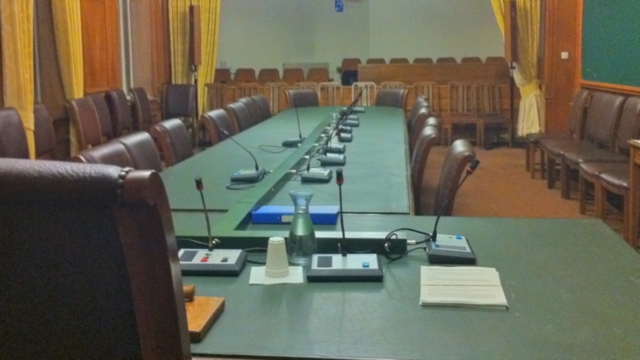
Given the scale of the financial challenge facing Wandsworth, it was hardly surprising that the latest Council meeting turned fractious — and not only because the standard meeting was followed by a separate session focused on the finance settlement that ran until midnight.
Labour leader Simon Hogg accused the Conservatives of forcing a supplementary debate on finances, while the Tories hit back, claiming he had deliberately delayed their request for a discussion and timed the additional meeting as late as possible. According to Conservative councillor Peter Graham:
“When we discovered in January that the February special meeting was not going to discuss the financial position of the Council, we asked for the item to be added and it was denied. A request to discuss it in a special meeting at the time was also denied. And Councillor Hogg personally took the decision to place the meeting tonight, after the meeting before.”
Hogg, for his part, chose to lean heavily on the council tax freeze throughout his interventions, repeating near-identical lines at the opening of each response (see our video below) and delivering a very long enumeration of his administration’s record. Even the cabinet member for finance closed her speech with the same refrain, prompting Conservative councillor Graham to observe: “I almost feel sorry for Councillor Ireland, who appears to have been forced handed a script — rather like those PR spokespeople in collapsing regimes.”
The Conservatives accused the administration of dishonesty about the scale of the black hole and its consequences for services. They hammered repeatedly on the officers’ note to the cabinet released on 23rd February 2026, which indicated that council tax could rise by as much as 86% (mentioned in details above). They also charged Labour with failing to use its closeness to the government to negotiate a better deal for the borough. Councillor Daniel Hamilton said:
“We often hear comments from Labour councillors about Sadiq Khan and the Labour government, about their proximity to power. We even had a claim from the leader this evening that the finance settlement was a triumph for Wandsworth — an example of good negotiation. So I ask: what went wrong? Because on the other side of London, their settlement is going up by more than £2m. Why do they gain so much while we suffer so much?”
On the Labour benches, the charges were met with familiar references to the council tax freeze and a catalogue of self-congratulation about the administration’s record over four years. Labour councillors also accused the Conservatives of being quietly furious that they had managed to keep council tax low — something, they pointed out, the Tories had long insisted was impossible under a Labour administration.
Occasionally the exchange rose above the rhetoric. Councillors Tony Belton and Jack Mayorcas cut through with candid questions — “What is your plan?” and “What will you do differently?” — directed at the Conservatives. A rare moment of cross-party honesty came when Councillor Dikerdem noted that the Tories had done precisely what they were now criticising Labour for: raising the social care precept by 2% while calling it a freeze. Conservative councillor Kim Cadie conceded: “Both sides are guilty of this.”
Those fleeting moments of agreement only threw the rest of the debate into sharper relief. The exchanges were deeply acrimonious, marked by attacks from both sides. Hogg accused the opposition of being bully boys, pompous, pedantic and angry. The Conservatives, in turn, accused Labour of cynicism and contempt. The temperature in the chamber ran so high that the Mayor, chairing the meeting, found several of his rulings challenged, and was accused of “dictatorship” by independent councillor Grimston.
Unsurprisingly, neither side was willing to show their hand ahead of the local elections. When Peter Graham pressed Aydin Dikerdem on whether Labour intended to raise council tax, Dikerdem was unapologetic: “If you think that on the eve of an election I am going to set the council tax for the following year, that is a crazy, unreasonable position.” It was politics, he added. “We’ve got to be frank: it’s a massive challenge.”
While admitting the likelihood of Council tax rise if they win, a Conservative member commented after the meeting:
“[If we win the next elections] we will face a huge financial challenge, but we won’t be boxed in to the same extent. For example, we can reduce planned borrowing well below Labour’s £1.1 billion. Labour wants to protect every penny of their planned expenditure. We don’t. We will cut waste and their pet projects, while protecting core services like weekly bin collections. But we won’t make their mistake of implying that tax can just stay where it is — we will only make promises that we know we can deliver.”
Options are limited: cut services, borrow more, and raise tax. Whoever takes control of the town hall after the elections, the pressures in the budget mean a tough choice ahead.
The Labour administration was contacted for comment but had not responded to our questions.
Video: A nearly 4 hours meeting summarised in less than 20 minutes:
More on the budget…
We did a previous analysis of the Council’s budget ahead of the previous local elections in 2022. Exactly 4 years later it is interesting to immerse again into Wandsworth Financial documents to see how it has evolved.
As in the past, the two documents we have used to understand Wandsworth budget(s) are the Statement of accounts (published 20 February 2026) and the Report by the Director of Resources on the Council Budget and Council Tax Setting 2026/27 (paper No 26-63).
The Revenue budget: the Council’s annual budget
The revenue budget is the money a council plans to spend on day-to-day services during a financial year (April–March). This includes things such as:
- adult and children’s social care
- waste collection and street cleaning
- libraries and parks
- planning and environmental health
- staff salaries and building maintenance
It is separated from from the capital budget, which is used for major investments like building schools, roads or housing. The revenue budget is not only funded by council tax, but also by business rates, government grants, fees and charges for services and reserves if necessary to balance.

The Council’s reserves
The most recent available figure (from the 2024/25 accounts) shows that the council had about £400 million in Fund reserves at 31 March 2025.
These reserves are composed of several categories, including:
| Type of reserve | Approx. amount (31 Mar 2025) |
|---|---|
| General Fund working balance | ~£15.0m |
| General Fund earmarked reserves | ~£193.9m |
| Section 106 revenue reserves | ~£130.4m |
| Collection Fund volatility reserve | ~£24.2m |
| Education balances | ~£15.8m |
| Insurance and other reserves | ~£17m |
| Total Fund reserves | ~£396.5m |
However, not all the £396.5m is available to fund budget gaps.
In reality, the Council has about £209m in reserves, made of the top two categories:
- £15m that is the real flexible cushion, completely free for immediate day-to-day spending (it is relatively stable as it was £15.3m at the start of 2024/25 and £15.0m at the end of the year after small movements) and
- the £193.9m figure labelled as General Fund earmarked reserves, which us the money that has been set aside for specific purposes (for example pensions resilience, renewals funds, or transformation projects).
This is technically also usable to balance the budget but require a political decision.
| Type | Amount (approx.) | What it means |
|---|---|---|
| General Fund working balance | £15m | Unallocated contingency reserve |
| General Fund earmarked reserves | £193.9m | Set aside for specific purposes |
| Total General Fund reserves | ~£209m | Working balance + earmarked |
Finance officers usually recommend councils keep a contingency of around 3–10% of their net revenue budget. For Wandsworth, it stands at 4.7% (we are considering the Net revenue budget and not the gross budget which includes housing benefit flows, service income. etc and therefore is above £1b) which is average, but the unusually large earmarked reserves provide additional protection.
Within the General Fund reserves, most of the controversy is directed on the Financial Resilience Reserve.

This £91m fund was established in 2014/15 by the Conservatives during the years when Wandsworth ran budget surpluses and kept spending growth low. It was justified as a cushion against future financial shocks and protect the council as they expected a decrease in government funding, which is exactly what is happening this year.